
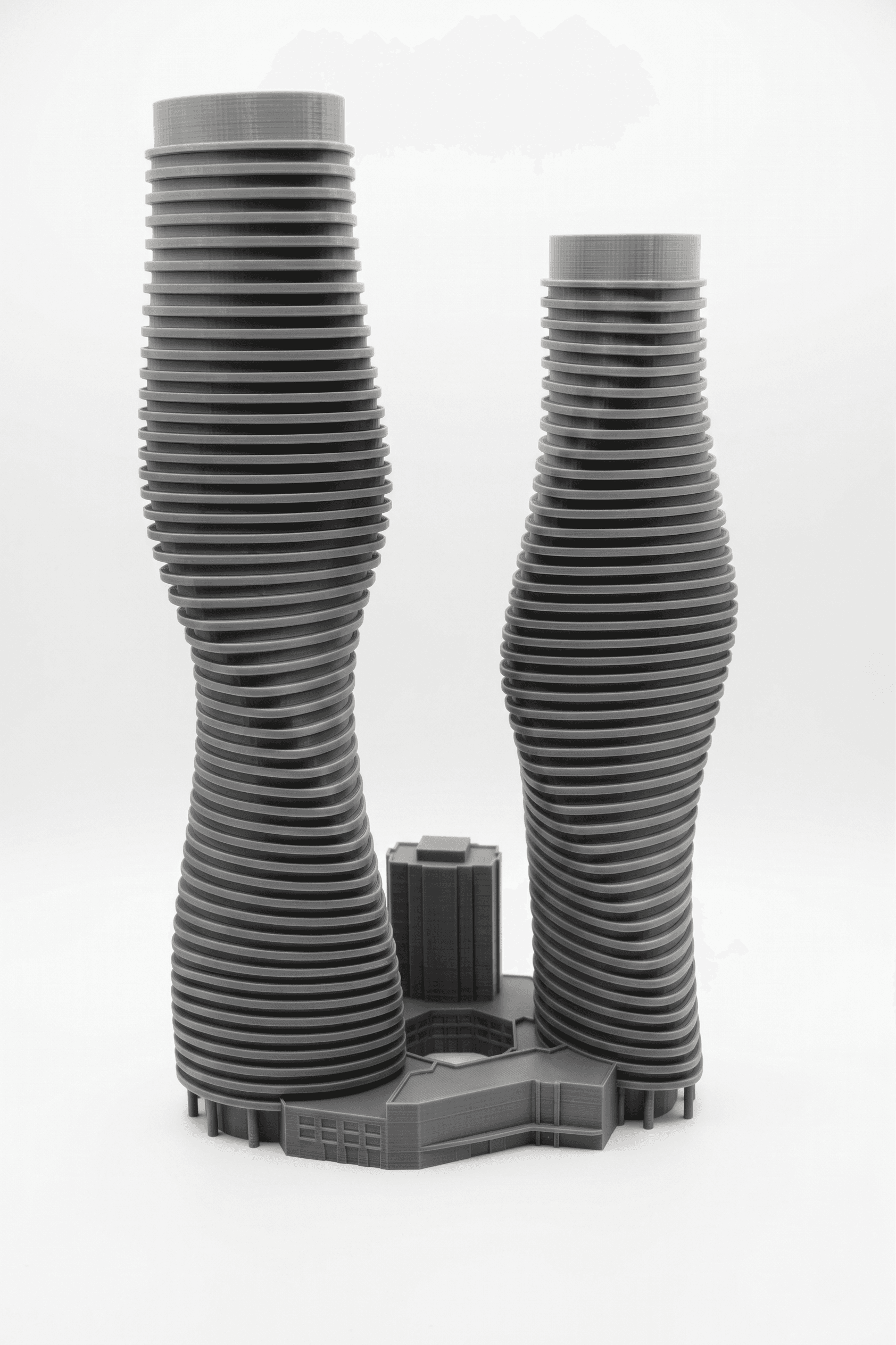
Most architecture firms in Toronto can't get a 1.6-metre building model made. Not because no one offers 3D printing services — there are plenty — but because the build volume required to produce a model at that scale, with architectural detail intact and tolerances that hold across the full height, sits beyond what standard equipment can deliver.
A premier Toronto architectural firm came to HexCode with exactly that requirement: a flagship model of their signature building, tall enough to stop people in their tracks when they walk into the head office. It was modeled and printed in 16 days.
The Challenge
The client's brief was specific: the model needed to be a showpiece, not a scaled-down approximation. It had to read as the building — full facade geometry, accurate proportions, the kind of presence that communicates the design intent to anyone who walks past it, whether or not they can read architectural drawings.
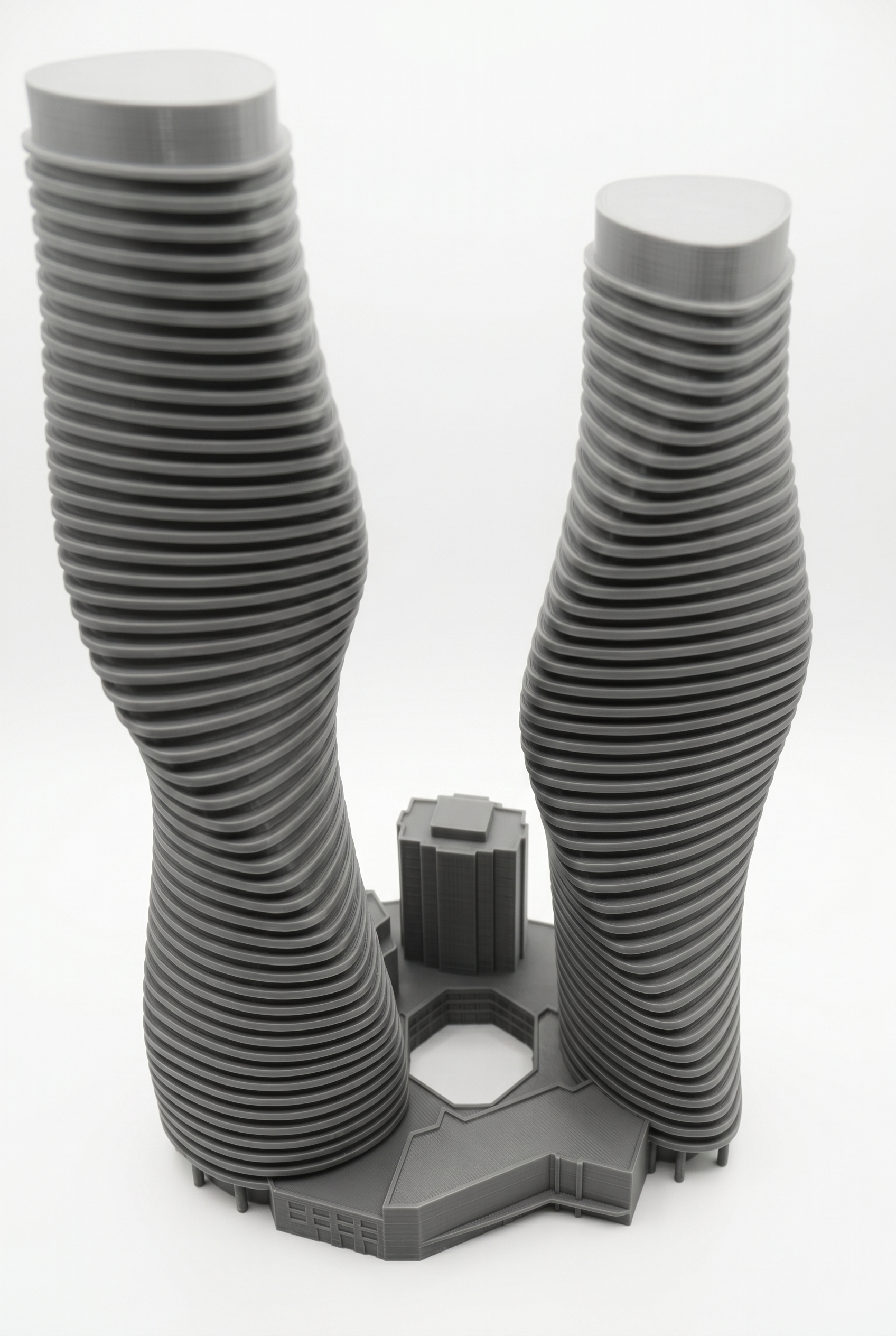
At 1.6 metres tall, the physical scale alone disqualifies most fabrication methods. Hand fabrication at that height produces models that are structurally fragile and difficult to finish consistently. CNC milling cannot economically produce complex curved or layered facade geometry at this scale. The GTA has no shortage of 3D printing providers, but the vast majority operate mid-format machines with build volumes that cap out well below what this model required.
The Approach
HexCode ran this on a custom large-format FDM printer with a 1000 × 1000 × 1500mm build volume — one of the few machines in Toronto capable of handling a model of this height without fragmenting it into unmanageable section counts.
Material selection was matte grey PLA. At this scale, surface finish consistency across a large print span matters more than exotic material properties. Matte grey reads as architectural — it sits neutrally, lets the building geometry do the work, and doesn't pick up glare or show layer variation the way glossy finishes do under office lighting.
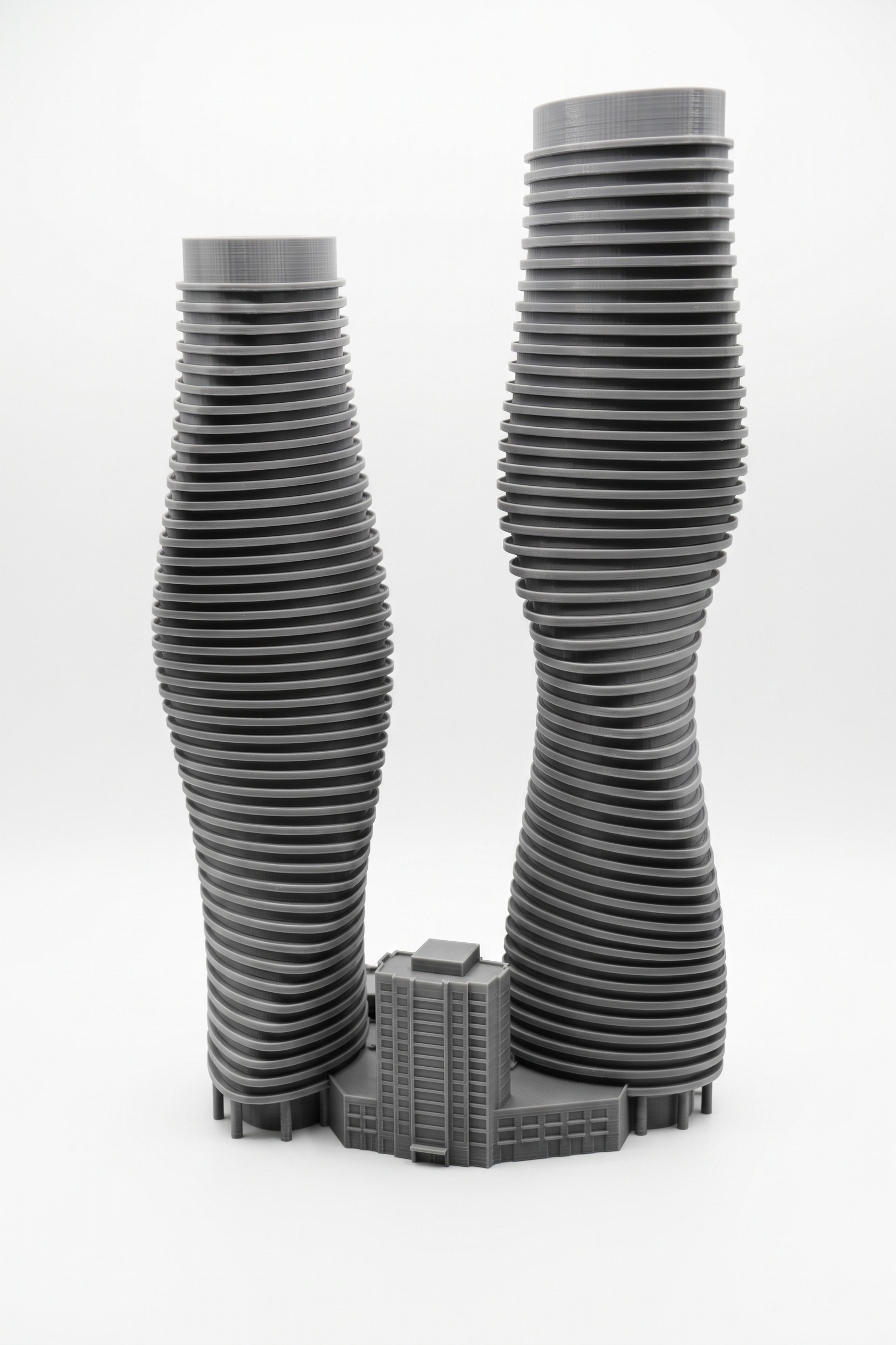
The model was divided into three parts: two towers and a base. This wasn't a compromise forced by build volume limitations — it was a deliberate assembly strategy. Three sections allowed each component to be oriented optimally on the build plate for surface quality, kept print times manageable, and gave the assembly joints predictable locations that could be finished to hide the seam.
The Outcome
Multiple floor plan models delivered within a 16-day lead time, each holding 0.05mm tolerance across the full height. Three-piece construction with seams finished and hidden. Every facade detail fully replicated from the client's building design files.
The model now sits in the firm's head office as the centrepiece it was commissioned to be. Visitors coming into the space encounter the building at a scale that communicates design intent immediately — no drawings required, no explanation needed. That's the function a flagship piece is supposed to serve: it positions the firm, demonstrates the quality of their work, and gives clients something physical to respond to before a single slide deck is opened.
Why It Matters for Architecture Firms in Toronto
A physical model at this scale isn't a prototype — it's a business asset. Architecture practices use flagship models to anchor their offices, anchor client pitches, and anchor their identity in a competitive market. The constraint has always been fabrication: producing a model of real architectural presence requires equipment and process expertise that most 3D printing services in Toronto simply don't have.
Large-format FDM changes that calculus. For building design firms working in AutoCAD or BIM environments, the geometry that defines a building's facade is already fully resolved in the digital model. The fabrication challenge is translating that geometry into a physical object at meaningful scale, without compromise on detail or tolerance.